This content is intended for healthcare professionals only
Break the cycle of
insufficient hay fever relief
Almost 3 in 4 hay fever sufferers use multiple medicines, often at the same time, yet many continue to experience severe symptoms.1,2 These patients can become stuck in a cycle of insufficient relief.
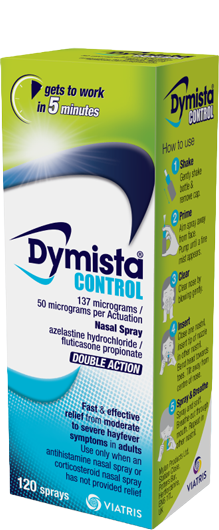
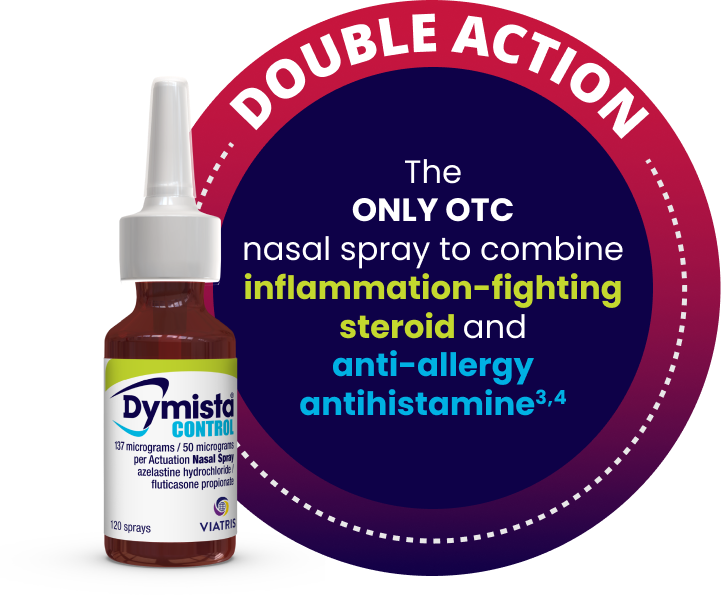
Dymista® CONTROL is the UK's ONLY OTC nasal spray to combine inflammation-fighting steroid and anti-allergy antihistamine,3,4 providing fast, effective relief to hay fever sufferers who are struggling to find symptom control.5-7
Dymista® CONTROL
provides fast, effective relief5,6

More effective
at reducing all EYE and NOSE symptoms of hay fever vs FP alone5 or FP + LORA6


Double action
The ONLY OTC nasal spray to combine inflammation-fighting steroid and allergy reducing antihistamine3,4

Fast relief
Gets to work in 5 minutes6

Recommended
by The British Society for Allergy & Clinical Immunology, when moderate-to-severe hay fever remains uncontrolled7
Learn more about breaking the cycle of insufficient hay fever relief with Dymista® CONTROL resources

Train your staff on breaking the hay fever struggle
Three short, simple learning modules for the whole pharmacy team. Helping hay fever sufferers to find effective relief starts here

Dymista® CONTROL quick guide
Download the quick guide to Dymista® CONTROL and fast-track your recommendations today
FP = fluticasone propionate; LORA = loratadine; OTC = over-the-counter.
Click here for Product information
References
1.Carr W, et al. J Allergy Clin Immunol. 2012;129(5):1282–1289.e10. 2. Pitman R, et al. Allergy. 2012;67(suppl 96):342–342. 3.OTC Directory. Available online: https://www.otcdirectory.co.uk/ [Accessed: February 2026]. 4.Dymista® CONTROL Summary of Product Characteristics. Available online: https://www.medicines.org.uk/emc/product/100345/smpc/print [Accessed: February 2026]. 5.Meltzer E, et al. Int Arch Allergy Immunol. 2013;161:369–377. 6.Bousquet J, et al. J Allergy Clin Immunol Pract. 2018;6(5):1726–1732. 7.Scadding G, et al. Clin Exp Allergy. 2017;47:856–889.
UK-DTC-2026-00019 March 2026